Here is what is needed to explore Mars under the European Commission project

Space News Europe – Here is what is needed to explore Mars and what would allow humans to settle on Mars, according to a study by the European Commission and the Marie Skłodowska-Curie Actions program published on February 13, 2026:
A new study by the European Commission reveals what is needed for humans to build a base on Mars. Here are the findings of the study carried out under the RED 4 MARS project by Rafał Anyszka who is working with the European Space Agency to literally re-invent the (Martian) wheel.
1 - Can humans live on Mars?
Mars, the red planet, is very cold and dusty, with huge temperature swings. While living on Mars could be rather pleasant with a temperature of 20 °C during the day, it plummets to -60 °C during the night.
Colossal dust storms frequently sweep around the red planet and completely encircle it every few years and could be a complication for future inhabitants of Mars as the dust is thought to be toxic.
Humans are preparing to explore Mars, and this requires re-inventing the wheels for transport to create a base on the red planet.
2 – What is needed to create a base on Mars?
Experts are designing materials that will withstand the environmental conditions on Mars, namely building materials to create a base for humans and wheels for transport on the red planet.
This is what is needed to create a base on Mars according to the study:
a – Humans need to literally re-invent the wheel to create transport on Mars:
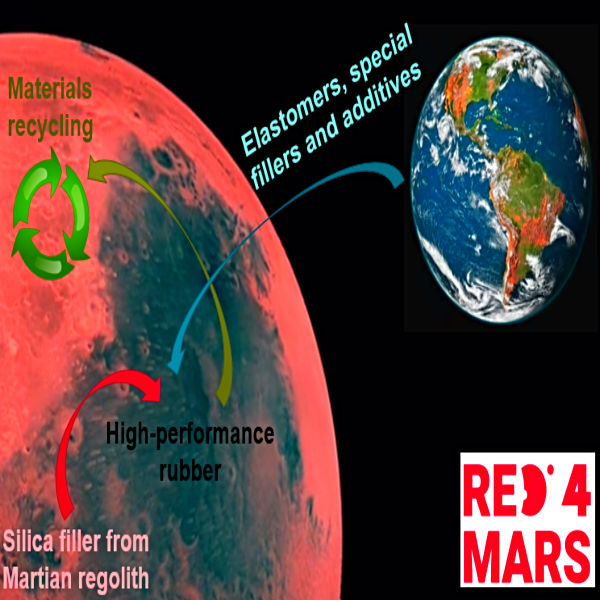
The team of experts from the RED 4 MARS project has developed a customized rubber wheel that can withstand the temperature swings on Mars that affect regular tyres for rovers to explore the red planet, especially under heavy loads.
The Martian wheels would be made of a rubber based on a mixture of silicone rubber and butadiene rubber, which testing showed can retain elasticity at very low temperatures.
b - Martian rubber
Rubber could also become a vital component for building a future base for humans on Mars: “If we need a dynamic ceiling, like doors, a ceiling that is opened and closed many times, then you really need a good seal, and rubber is the best material,” stated RED 4 MARS project expert, Rafał Anyszka.
c – Locally-sourced building supplies are needed to build a base for humans on Mars:
Building a base for humans on Mars requires building materials that will keep both the heat in and the dust out. While concrete would be a good option, it requires a lot of water as a binder, and there does not seem to be an abundance of water on Mars.
One promising alternative as binding agent for concrete on Mars is sulfur. Moreover, sulfur provides better resistance to the abrasive dust that sweeps the planet and is a locally sourced building material, since the dust and rocks covering the surface of Mars contain a variety of sulfates which could be extracted. To work as a binding agent, the sulfur on Mars needs to be stabilized with carbon, which could be obtained from the planet’s thin atmosphere. The rocks and sulfur of Mars can therefore be used to produce Martian concrete for building a base for humans on Mars.
d – Flexible materials
The European Space Agency is working on designing flexible materials to be used in origami-style structures in space and on planets. Flexible materials are needed to unfold for spacecrafts to enter the Martian atmosphere and increase the surface area used for braking on descent.
“Then we could either land in thinner atmospheres, like on Mars, or bring down bigger elements, like the last stages of Ariane rockets,” stated Anyszka.
3 – Why is the European Commission investing in Space-based projects?
In the current geopolitical context of increasing power competition and intensification of threats, the EU is taking action to protect its space assets, defend its interests, deter hostile activities in space and strengthen its strategic posture and autonomy.